
Jill and I enjoy watching Sherlock Holmes films. To be honest, I’m more of a fan than Jill for mysteries involving Holmes and Watson. Jill is a fan of the films. I also like the books. I haven’t merely read the books, I also have modern facsimiles of the original Strand publications of the Conan Doyles stories. And a complete collection of the uniform set of paperbacks by Penguin Books that was issued some decades ago. And books about the books. And DVDs. And so on. Now stop right there! Before you picture me as a die-hard Holmes fan who goes around wearing a deer-stalker hat and quoting Holmes at every opportunity I would like to point out that I don’t take my interest that far.
I like reading, I read a variety of topics, and Sherlock Holmes is just one among many interests. Okay, I’ve worn a deer-stalker hat once. Only once. Yes, okay, I’ve had my photograph taken wearing a deer-stalker hat. And that was when Jill and I went to The Sherlock Holmes Museum in Baker Street, London. However, all that the photograph did for me was prove that I shouldn’t wear a deer-stalker hat. It just doesn’t suit me. Most hats don’t. Even the Victorian top hat didn’t look good on me. Yes, okay, I tried on the Victorian top hat in the museum and had a photograph taken of that too. Neither photograph appear here because of how much they don't suit my face. Or rather how much my face doesn’t suit a good hat. I prefer to blame the hats.
Anyway, The Sherlock Holmes Museum is worth visiting if you enjoy the films, television series or the books. Like any museum or exhibit there are good points and bad points. The good points of The Sherlock Holmes Museum far outweigh the bad and the bad points could easily be put right.
To begin with the good points. The shop is on the ground floor and the rest of the building, right up into the attic, is the museum. The entrance fee to the museum part of the building is very fair; probably the lowest fee I know of in London. Even if you’re only interested in Victoriana, the museum could be of interest to you because most of the knick-knacks and everyday objects in the rooms are genuine articles from the correct period of the Holmes stories of 1881-1904. Also, the building used for the museum was actually used as a lodging house during the Victorian period and later (from 1860 right though to 1934) and so the layout of the rooms isn’t merely in accordance with the descriptions in the stories of the lodging house at which Holmes resided, it does give some genuine idea of the look and feel of a Victorian gentleman’s rooms.
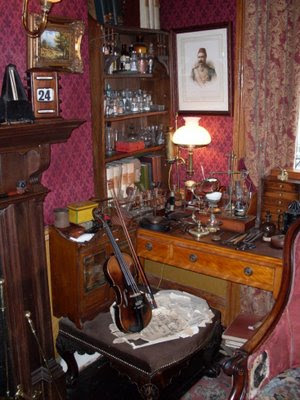
In amongst the bits and pieces which provide an authentic look to the rooms are modern fakes, such as letters by Holmes to Watson. Also on display is a small selection of books from the publishing history of Holmes by Conan Doyle and others. Wax figures are to be found in some of the upper rooms; they each portray a scene from the stories. Their design matches the original illustrations from The Strand Magazine. I must admit that I don’t find such figures interesting but then I’m in a minority with that opinion. What was interesting and entertaining was Dr. Watson. Yep, an elderly gentleman hired to portray Watson was delighting some of the visitors with his friendly chit-chat about the adventures he had ‘shared with Holmes.’ He had a sense of humour and I think he was basing his Watson on that of the portrayal by Nigel Bruce in the films co-starring Basil Rathbone. Regrettably, Holmes wasn’t present to greet us; the museum is presently advertising a vacancy for someone to portray him.
We found every room interesting. There was a lot to take in and we just didn’t have time to scrutinise every little thing.
That was one of the three bad points. You would have to be Sherlock Holmes to spot every little detail portrayed in the rooms; or at least an astounding expert on the stories by Conan Doyle with a photographic memory. This was because very little was labelled. I imagine it would impossible to do so because the sheer amount of small items in the rooms. An audio commentary for each room, as can be found in other museums, might improve the situation. To be fair, such audio commentaries are expensive for a museum to acquire and maintain so perhaps that might be why there isn’t one.
The second bad point is one shared by most museums, especially those in London: the price of some of the items in the shop. The items for sale are great; you can buy the Sherlock Holmes stories in various editions, buy books about Sherlock Holmes, DVDs, replicas of Victoriana and so on - just don’t expect to find a bargain. Some of the items, well, most in this case, are available elsewhere at lower prices. Again, to be fair, most museums, if not all, are simply not in a position to give the reductions on prices to be found in ordinary shops. The almost annual reduction in funding to museums over the past number of decades has meant that they have had to become more commercial.
The third bad point was some of the staff. The woman who sold us our tickets couldn’t have been more strict and stern with us as she spoke. In the rooms above, a young man dressed in period costume, was more interested in reading a paperback than interacting with the visitors. It felt somewhat uncomfortable to have to interrupt his reading to ask him about some of the exhibits. One excruciatingly embarrassing moment took place in the shop. A male member of staff who looked middle-aged, the only person not in period costume and wearing bright white trainers, left the till unguarded at the back of the shop so he could, quite audibly to all the visitors in the shop, try to impress/chat up a very quiet and less than happy looking teenage girl sat at the front of the shop. The girl, dressed as a maid, stayed very quiet as he spoke to her in soft and gentle tones. His verbal fawning and her discomfort were just too much and so it was time to leave. We went to the till at the back of the shop and he was obliged to follow. The tone of his voice to us as we paid for our items was not soft and gentle. His manner was brusque and his tone a little gruff. Perhaps he didn’t like his private life being interrupted by work during work hours.
As we left, we fulfilled the obligation of a simple courtesy that is customary; in order to leave the shop we had to walk pass museum staff that we had spoken to earlier and so we said thank you and goodbye. There was no reply. We were ignored. That’s a first; even in London.
In the museum the building is great, the exhibits are great, what you can buy is quality and the entrance fee is very reasonable; I do recommend the place to anyone interested in Sherlock Holmes or the late Victorian period – however, if you do visit, brace yourself with quite a bit of patience regarding the behaviour of some of the staff.
A link to the museum’s website:
http://www.sherlock-holmes.co.uk
 About a week ago I took Jill to visit the Georgian House Museum on Great George Street, just off Park Street in Bristol. Jill is avid about all things Georgian, especially if related to Jane Austen or gives an insight to the period in which Austen lived. She said she preferred this house to the one in Bath - No 1 Royal Crescent. There are differences, such as the museum in Bristol is free whereas No 1 Royal Crescent has an admission fee. I think both are excellent. I can see some differences due to a fee being charged for the Georgian house in Bath. They can afford to finance a shop, guides and so on. The lower amount of funding for the house in Bristol is apparent if you know what to look for, or rather to look for what is missing in terms of staff, brochures, a shop and so on. Even so, a lot of care has gone into making the Georgian House in Bristol well worth a visit (or more than one).
 The man who had the house built was John Pinney. Here is a portrait of him in one of the rooms. Pinney was a wealthy slave plantation owner and the house has a room dedicated to the subject of slavery during the Georgian period and its connection to Bristol. It is not often that I see a house museum highlight, in any way whatsoever, the human cost that made the original owner wealthy enough to afford such a house. Even when a house was built by someone who had no direct connection with slavery, it was still a period when William Blake justifiably wrote of some working conditions in Britain as being within ‘Dark Satanic Mills.’
 The house has on the walls, besides portraits of Pinney, paintings from the Georgian period including one by a relation of Sir Joshua Reynolds. In the dining area is one that has a detail that may be of interest to magic historians. It is of three children and one is building a house of cards. Look carefully at the cards and you will see that the backs of the cards are blank and the corners are square and not rounded. Similar cards are on display on a card table in another room. Packs of cards which are reproductions of those from around that period can be bought from The Card Collection. I bought a deck for Jill last year. What is interesting from a conjuring point of view is how very different the physical quality of the cards are from modern day ones and how much that affects using sleight of hand.


